Bedtime Fears: What to Say When Your Kid Won't Sleep Alone
It's 9:40pm. You've done the water, the second story, the hallway light. Then the small voice again: "Can you just stay?" Bedtime fears are one of the most common things kids bring to parents — and one of the easiest to accidentally make worse. Here's what to say instead.
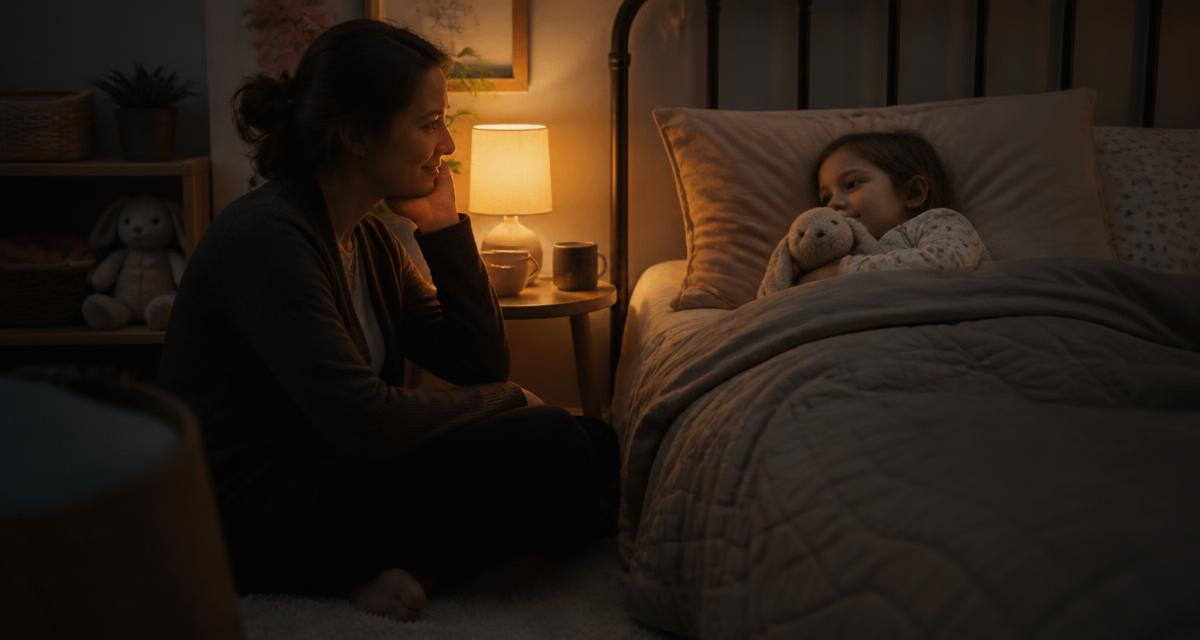
Why kids get scared at bedtime
Somewhere around age three, imagination gets powerful before the reality-check part of the brain catches up. A coat on a door really can look like a person. Add the quiet, the dark, and the fact that you just left the room, and a child has nothing to push back with except you. That's not manipulation. It's a nervous system asking for a co-pilot.
Which means the goal isn't to prove the fear wrong. It's to hand your child something they can use when you're not in the room.
What not to say
- "There's nothing to be scared of." True, and useless. It tells a frightened kid their feeling is a mistake, so next time they hide it.
- Monster spray. It works for a week, then backfires — you've just confirmed monsters are real enough to need chemicals.
- "Big kids sleep alone." Shame doesn't build courage. It just adds a second thing to feel bad about at 10pm.
- Bargaining. "If you stay in bed you get a treat" turns bedtime into a negotiation you'll have to re-open every night.
The 4-step script for bedtime fears
1. Name it, plainly
"Your body feels scared right now." Not a question, not a debate. Naming a feeling out loud measurably lowers its volume — for adults too.
2. Say what's true about the room
"The door is open. I'm in the kitchen. The house is locked." Facts, not reassurance. Reassurance ("you're fine!") gets argued with; facts don't.
3. Give them one job
A scared brain wants something to do. "Breathe out longer than you breathe in, five times." Or: "Find three things in the room you can see from your pillow." A job converts fear into attention.
4. Shrink the distance slowly
If you've been lying in the bed, sit on the edge this week. Next week, the chair. Then the doorway. Then the hall, calling out once. Small, boring steps beat one dramatic night — and each step is proof they handled it.
A 10-minute wind-down that actually works
- Screens off — the same time every night, no countdown drama.
- Dim the room. Lamp, not overhead.
- One story, then one line each about the day: something hard, something good.
- One short quote or affirmation, read out loud by your child.
- The same closing sentence, every night. Repetition is safety.
That fourth step is small and does a surprising amount of work. A line your child says out loud in their own voice — "I can do hard things" — lands differently from anything you say for them. Our 100 printable affirmation cards are built for exactly this slot, and the daily checklist gives the routine a shape kids can follow themselves.
Common questions about bedtime fears
Why is my child suddenly scared at bedtime?
Night fears usually appear between ages three and eight, when imagination outruns a child's sense of what is real. A move, a new school, a scary clip, or a stretch of poor sleep can all set it off. In most children it is a developmental phase, not a sign that something is wrong.
Should I let my child sleep in my bed?
An occasional night is fine. Nightly co-sleeping that both of you resent tends to make the fear larger, because the child never gets evidence that they can handle their own room. Aim for the smallest amount of help that still lets everyone sleep, then shrink it week by week.
What should I not say about bedtime fears?
Skip 'there's nothing to be afraid of' and skip monster spray. The first argues with a real feeling; the second confirms that monsters are real enough to need spray. Name the feeling, then name what is true about the room.
How long does it take for bedtime fears to go away?
With a consistent routine and gradual distance, most families see clear improvement in two to three weeks. Progress is rarely straight — expect a bad night after a big day and treat it as normal, not as a reset.
When should I talk to a doctor about my child's night fears?
If the fear spills into daytime, causes panic that will not settle, keeps your child from school, or lasts months without any improvement, it is worth raising with your paediatrician.